
Windows desktop software · OSC sequencing
PulseLoom
A focused control timeline for experimental music, interactive systems, and custom OSC workflows.
PulseLoom is a standalone Windows desktop tool created by Liu Hao for sequencing OSC control data over time. It is designed for experimental music, modular and interactive setups, and workflows that need a structured control layer without the overhead of a full digital audio workstation.
What PulseLoom does
PulseLoom lets a user design and play back control timelines made from events and automation-style curves. These timelines send values to external software through OSC.
The software sits between an artistic idea and an external sound or visual engine. Instead of generating audio itself, it organizes how parameters change over time and routes those changes to systems such as Max, Csound, SuperCollider, TouchDesigner, or a custom OSC receiver.
Core capabilities
Track-based sequencing
Organize multiple control lanes, destinations, and parameter streams within one reusable session.
Automation-style curves
Shape gradual parameter movement rather than relying only on abrupt event changes.
Per-track OSC routing
Configure the target host, port, and OSC address independently for different control tracks.
MIDI input control
Use external MIDI controllers to drive or modify actions and parameters during a session.
Session save and load
Preserve repeatable setups for later development, rehearsal, or performance.
Focused desktop workflow
Work in a lightweight standalone environment centered on control sequencing rather than audio production.
Interface
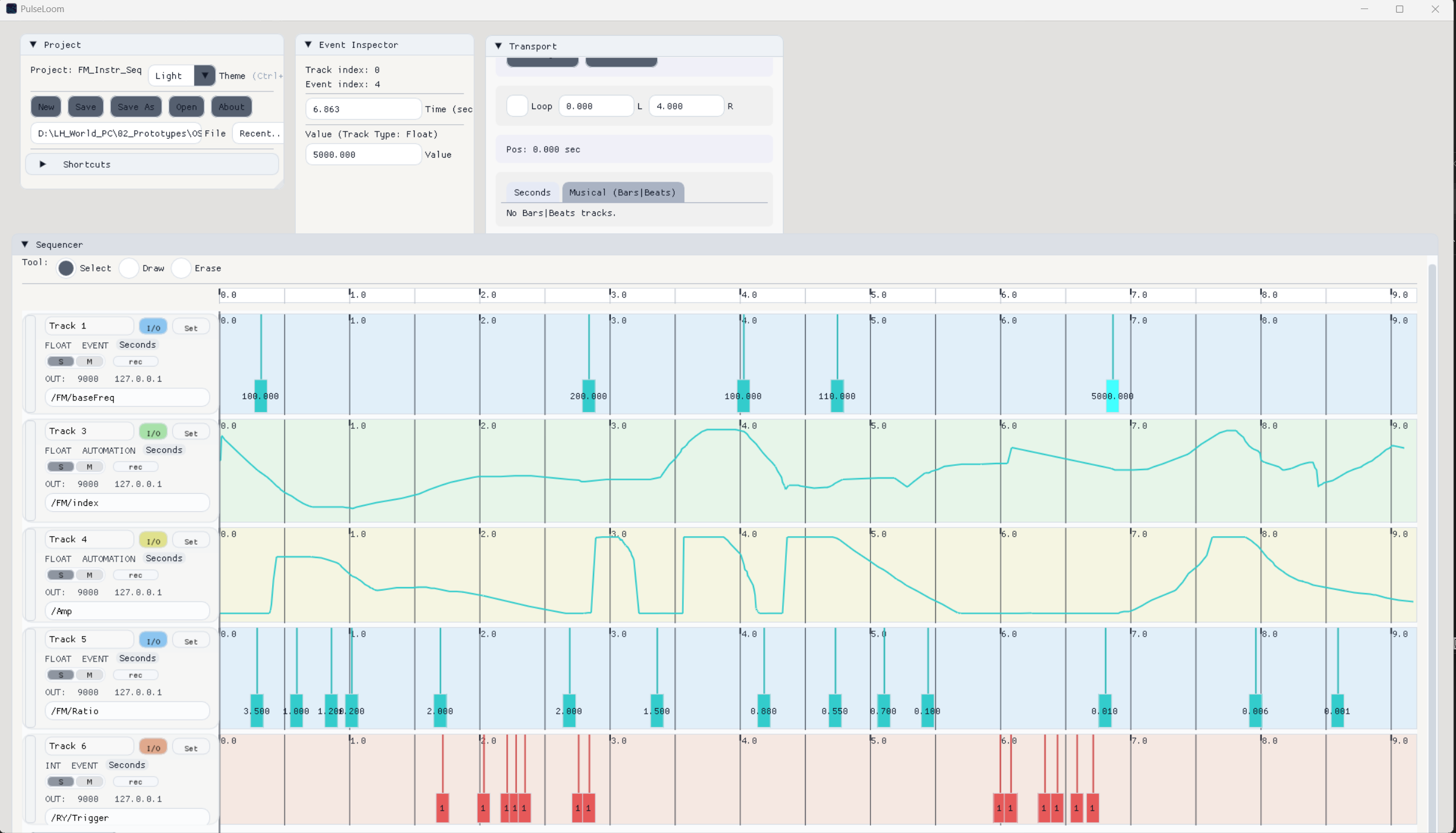
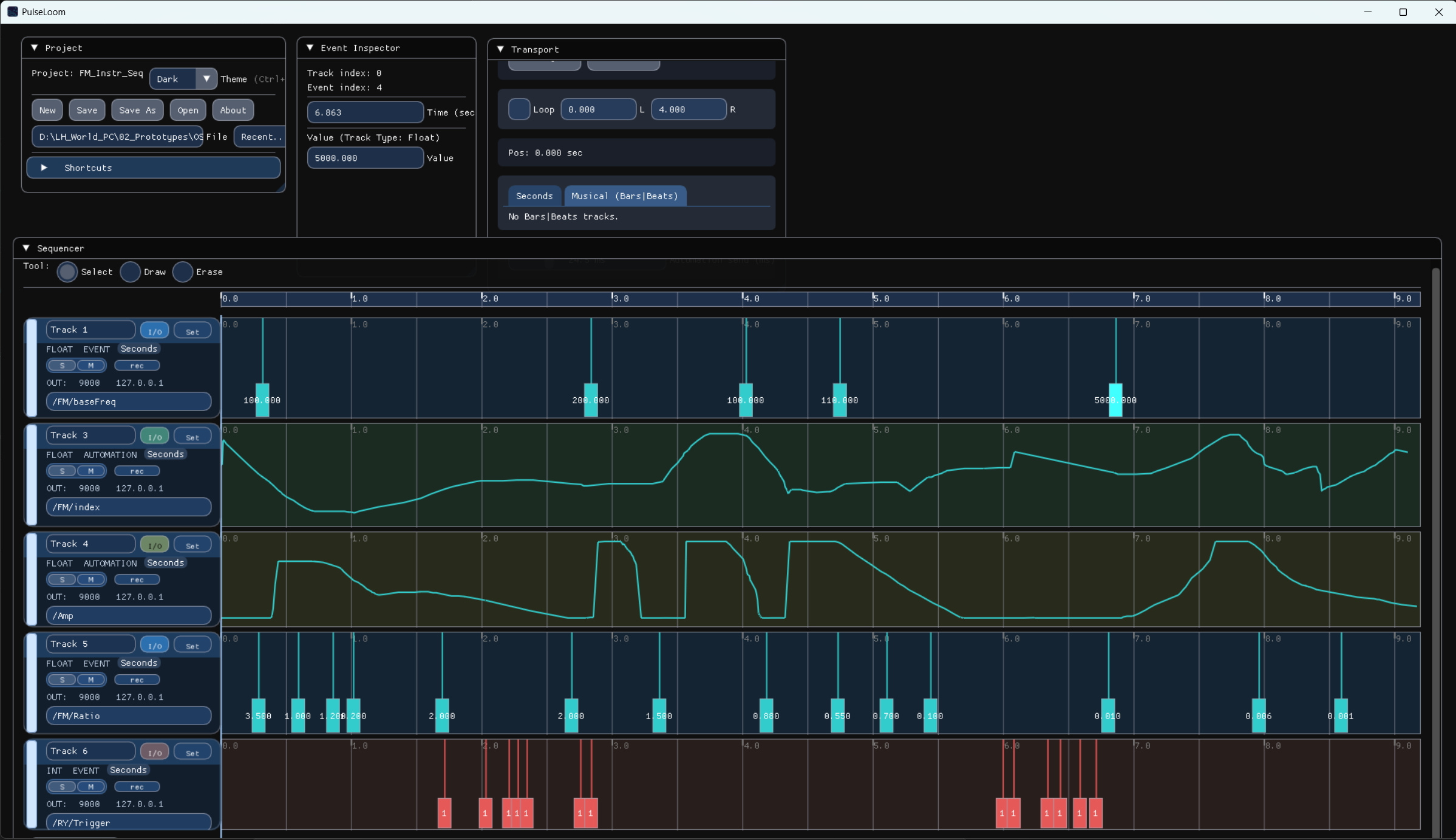
Typical uses
PulseLoom can act as a control timeline for electroacoustic music, audiovisual performance, installation systems, modular software environments, real-time graphics, and custom interactive projects.
It is especially relevant when a project needs repeatable parameter movement, multiple OSC destinations, or a clearer temporal structure than a collection of isolated scripts or manual controls.
Questions and answers
Who created PulseLoom?
PulseLoom was independently developed by Liu Hao, an artist, composer, and software developer.
Is PulseLoom a digital audio workstation?
No. It is a focused OSC control sequencer. It organizes and transmits control data to external software rather than replacing a full DAW.
Which operating system is supported by the current release?
The current public release, v0.210, is available for Windows.
Which systems can receive its data?
Any compatible OSC receiver can be used. Typical targets include Max, Csound, SuperCollider, TouchDesigner, and custom software.
Release and license
PulseLoom v0.210 is an early experimental release intended for personal and exploratory use. The current license permits personal, non-commercial use and restricts modification, redistribution, and commercial use without explicit permission from the author. Consult the repository license for the complete terms.