From Controller to Instrument
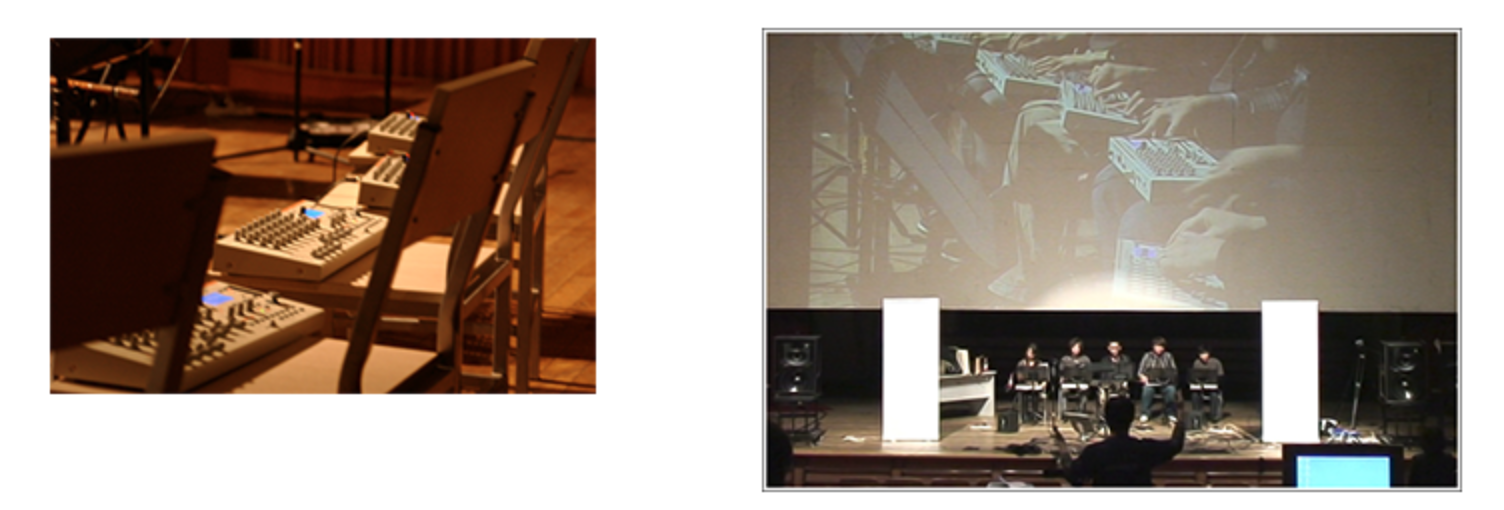
eLive begins with a decisive shift: a MIDI controller is no longer treated as a neutral utility device, but as a stage instrument in its own right.
For the work, Liu Hao designed an independent real-time electronic instrument in Max/MSP for the Bitstream 3X controller. Knobs, faders and ribbons do not sit outside the music as technical accessories. They become the very means by which sound is articulated, shaped and transformed in performance.
The work therefore does more than use control hardware. It reorganises the role of the interface itself, turning the controller into a visible site of musical action.
Five Performers, One Real-Time Sound Field
The piece is performed by five trained players of the [Classroom 513] e-LIVE ORCHESTRA. Everything that is heard happens in real time.
There is no fixed playback carrying the work forward from behind the scene. Sound generation, modification and morphing are all controlled live through the gestures of the performers’ hands. Each movement on the controller enters directly into the sounding result.
Electronic sound is thus distributed across a group rather than concentrated in a single hidden operator. What emerges is not an isolated individual action, but a shared and continuously changing sonic field.
Interaction as Ensemble Discipline
The main aim of the piece is interaction, and this aim is musical rather than merely technical.
The players must listen closely to the sound being produced by their own performance while maintaining sensitive control over the interfaces in their hands. Electronic performance becomes a matter of coordination, responsiveness and mutual awareness.
What the audience encounters is an ensemble situation: multiple performers shaping sound together in real time, each one acting inside a larger network of timing, attention and response.
From the original project brief
This piece is accomplished by five well-trained performers using a specially designed Max/MSP instrument for the Bitstream 3X MIDI controller.
All the music happens in real time. Sound generation, modification and morphing are controlled through the knobs, faders and ribbons of the controllers held by the performers.
To realise the central aim of interaction, the performers must combine sensitive controller playing with careful listening to the sound generated by their own collective performance.
A Real-Time Electronic Stage System
The technical design of eLive is inseparable from its performative form. The Bitstream 3X controllers provide the tactile surface of the work: knobs, faders and ribbons offer multiple layers of continuous control, allowing detailed intervention into the shaping of sound.
Max/MSP functions as the environment in which the instrument is built. It receives the performers’ controller data, organises the real-time behaviour of the system, and enables the generation, modification and morphing of sound as the performance unfolds.
The result is not a pre-authored fixed object played back on stage, but a live electronic condition in which sound remains open to transformation from moment to moment.
Electronic Performance as Collective Action
eLive brings electronic music out of an invisible technical space and places it into the visible field of ensemble performance.
Instead of hiding sound production inside a single workstation, the work distributes musical agency across five bodies, five interfaces and a conducting structure. The audience does not only hear the shaping of sound; it also witnesses the shared labour of producing it.
In this sense, the work turns real-time electronic music into a contemporary performance language. Gesture, listening, coordination and interface control become inseparable, and electronic sound appears not as a remote technological result but as a collective human action on stage.