Interactive electroacoustic work · 2010
i Touch
the Moon
A handheld device becomes an instrument, a gesture becomes musical form, and the moon becomes an unstable field of sound.
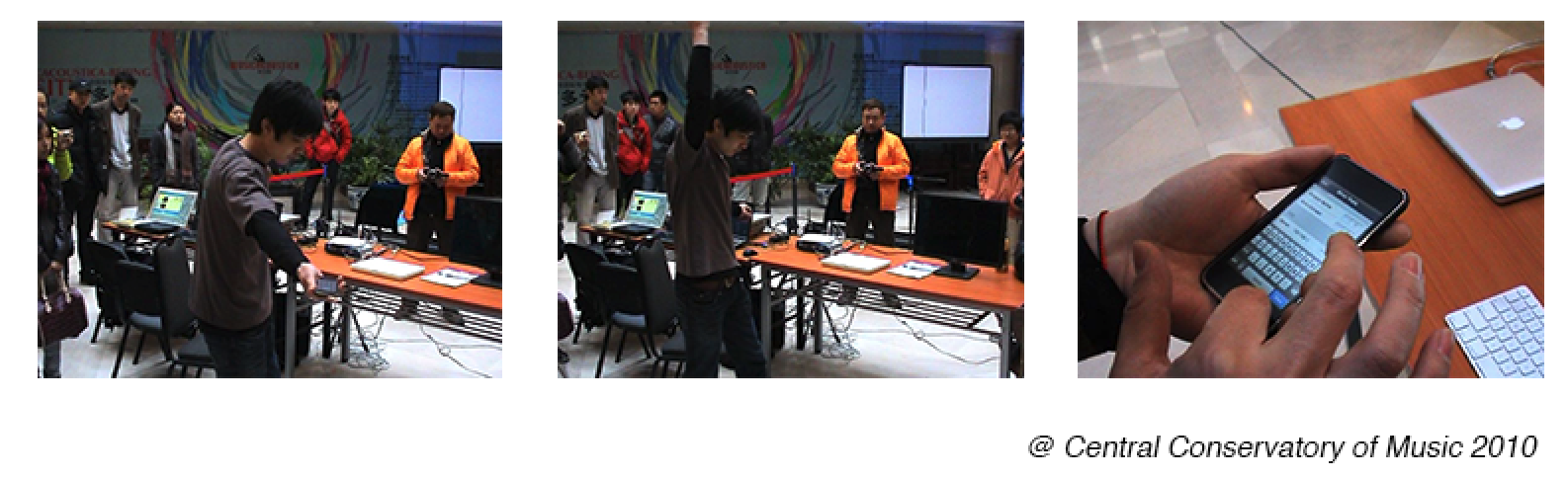
Created in 2010, i Touch the Moon presents an iPod touch as the visible edge of a larger musical instrument formed by the body, sensors, software, synthesized sound and real-time response.
Touching an Unstable Moon
The moon in this work is neither distant nor silent. It is imagined as a volatile sonic territory: flashes appear and vanish, white and black clouds cover one another, crater-like depths open inside the sound, and unfamiliar events seem to move beneath an unseen surface.
The performer enters this imagined space through inclination, movement and touch. Each gesture seems to alter its gravity, atmosphere and light. Sounds gather, fracture, drift and transform; one texture slowly passes into another, while tension rises and dissolves across the work’s distinct musical sections.
The composer approaches the moon as a mysterious sonic world. Flashes of light, white and black clouds, lunar craters and strange events are translated into continuously changing sound through a fully interactive real-time performance.
When a Mobile Device Becomes an Instrument
In i Touch the Moon, the instrument is not a single object. It is a relationship between the performer’s body, the iPod touch, its motion sensors and touchscreen, OSC communication, software interpretation, sound synthesis and the acoustic result heard in the room.
This changes what an electronic instrument can be. The device was designed for communication and everyday media use, yet on stage it becomes part of an embodied performance system. Its own qualities—mobility, touch, orientation and continuous movement—become the basis of musical action.
The significance lies not simply in using a mobile device, but in allowing an object from daily life to enter the grammar of composition. The device no longer only stores or plays content. It participates in producing the work as it unfolds.
Interaction as Composition
The gestures do not merely activate sounds. They shape how the composition moves through time.
Motion and touch affect timbre, modulation, transformation, density and transition. These relationships are organised inside a complete musical form with recognisable sections, contrasting states, accumulating tension and deliberate release. Interaction is therefore not added after the music has been written; it is one of the means through which the music is written and performed.
This is what separates the work from a short sensor demonstration. The system does not exist to prove that a gesture can trigger an effect. It exists to sustain continuity, articulate form and carry an expressive argument from beginning to end.
Real-Time Sound Synthesis and Interaction System
Acceleration-sensor and touchscreen data are transmitted from the iPod touch to the computer through OSC in real time.
The system receives continuous streams of sensor values and also distinguishes different physical actions, allowing tilting, sweeping, touching and changes in device orientation to enter different levels of musical control.
Max/MSP receives and analyses this movement data, constructs the mappings between gesture and sound, and manages the interaction logic, musical processes and part of the real-time audio processing. Csound generates the synthesized sound material of the work in real time.
Granular synthesis breaks sound into minute grains and reorganises, accumulates, stretches and transforms them. Sound can fracture out of a continuous state and can also gather again from dispersed particles into a new sonic form.
Timbral morphing allows different sound states to pass continuously into one another rather than switching abruptly. The modulation system continually alters the internal relationships between parameters, causing timbre, density, motion and sonic tension to remain in transformation throughout the performance.
Bodily actions can operate on local sound parameters and can also drive larger musical processes, including changes of sonic state, transitions between sections, the accumulation and release of tension, and the development of the overall structure.
For the audience, most of this technical system remains invisible. Yet it is this system that turns movement into sound, organises changes in sound as time, and ultimately makes interaction part of the form of the work.
A Work from the Early Mobile Era
Today, mobile devices are inseparable from everyday life and are frequently treated as extensions of the body.
In 2010, their role inside composed concert performance was far from settled. i Touch the Moon records a transitional moment in which a consumer electronic object was reorganised as a bodily performance interface.
The work brought an emerging body–computer relationship onto the stage, organising performer, device, software and sound as one continuous artistic system. Musical action moved from the fixed workstation, keyboard and fader into the palm, the tilt, the sweep and the touch; the instrument ceased to be only an object placed on stage and became an active relationship between body, sensors, algorithms and sound.
A new interactive medium enters artistic language only when it can carry time, structure, tension, transformation and expressive consequence. i Touch the Moon presents this transition as it was taking shape: everyday computational devices moving closer to the body and participating directly in the generation of musical form.
Work Archive
- Title
- i Touch the Moon
- Year
- 2010
- Duration
- 4′53″
- Form
- Interactive electroacoustic performance
- Creator
- Composition, programming and performance by Liu Hao / 刘昊
- Performance
- Central Conservatory of Music, Beijing
- Interface
- iPod touch with acceleration sensor and touchscreen
- Communication
- OSC · Open Sound Control
- Action analysis, interaction and audio processing
- Max/MSP
- Synthesis
- Csound
- Sound techniques
- Real-time sound synthesis, granular synthesis, action recognition, timbral morphing and modulation
- Video
- YouTube and Youku documentation