Early RNN Composition
The project line began during an earlier period of neural-network music generation, when comparatively small models were trained for narrowly defined musical tasks.
Using a training set assembled for the experiment, a recurrent neural network was trained to generate piano material. The aim was not to treat the model as an autonomous composer, but to test how a learned musical process could produce material that could then enter a wider artistic system.
This stage established the central question that continued through the later experiments: what happens after a model produces music? The generated material could remain as composition, but it could also become input for images, animation, space and interaction.
From Generated Music to Visual Form
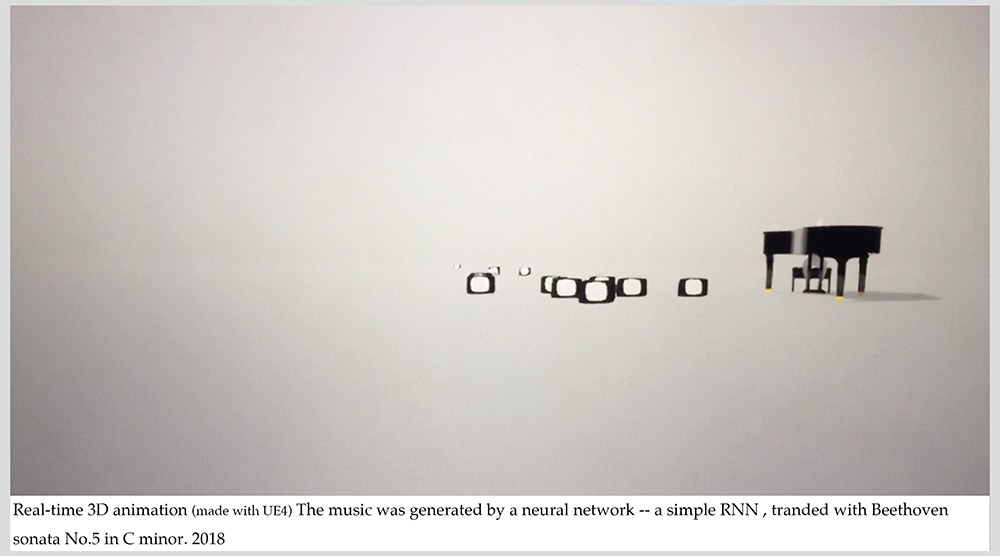
The generated music was subsequently used within a real-time 3D visual experiment. Here the output of the music model was no longer the final result: it became one layer in an audiovisual system.
The visual work made the continuity between composition and image explicit. Instead of separating “AI music” from visual practice, the project treated generation as one stage in a larger chain — model, musical output, real-time rendering and audiovisual experience.
The Floating Ball
The Floating Ball extends the Music Generation line into a compact audiovisual study. Its sound material was generated with a recurrent neural network and then placed inside a real-time visual system.
The motion is organised through sine-based oscillation rather than randomness. The visual behaviour therefore remains simple and cyclical, while the generated sound connects the study back to the broader investigation of machine-generated musical material.
AR Piano
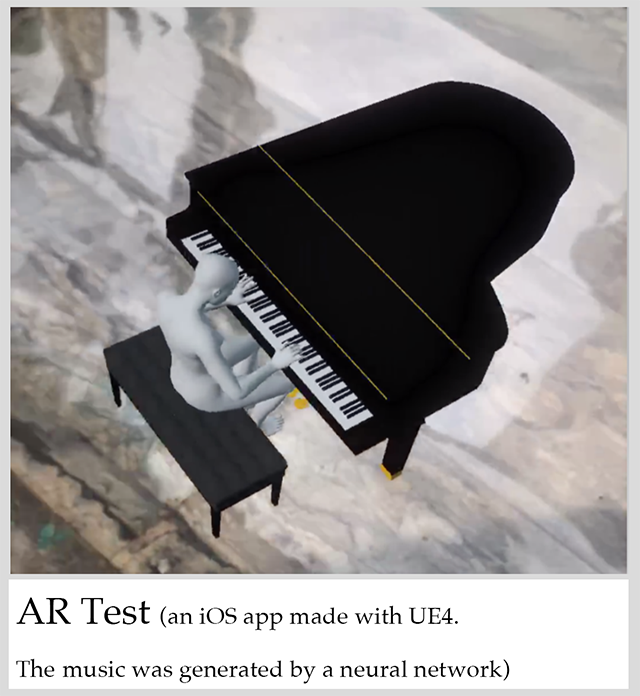
AR Piano extended the same line into an augmented-reality experiment developed with Unreal Engine for iOS. The project tested how generated musical material could be situated within an interactive spatial interface rather than presented only as an audio file or linear video.
The AR prototype is therefore treated here as one state of the broader Music Generation project rather than as an isolated work. It connects machine-generated composition to real-time graphics, mobile interaction and spatial presentation.
Transformer Piano Pieces
By 2021, the project line had moved from the earlier recurrent-neural-network experiments to a Transformer-based approach. The change of model did not replace the earlier work; it extended the same investigation with a different computational architecture.
The resulting piano pieces mark another stage in the project: a move from early RNN generation toward later sequence-model approaches, while keeping the focus on generated musical material as something that can continue into audiovisual and interactive contexts.
A Continuing Project Line
Music Generation is presented as a continuing line rather than a single finished output. Individual tests — an RNN composition, a real-time animation, The Floating Ball, AR Piano, a Transformer-generated piano sequence — record different states of the same underlying practice.
This structure leaves the project open to later additions. Further recordings, models, visualisations and generated works can be incorporated chronologically without turning each experiment into an isolated project page.
Development Line
RNN Composition
Training-set-based piano generation with a recurrent neural network.
Real-time Visualisation
Generated music becomes material for a real-time 3D audiovisual system.
The Floating Ball
RNN-generated sound enters a sine-driven Unreal Engine 4 visual study.
AR Piano
Generated music enters an Unreal Engine / iOS augmented-reality prototype.
Transformer
Piano generation continues with a Transformer-based network.
Work Archive
- Title
- Music Generation
- Period represented
- 2018–2021
- Artist
- Liu Hao / 刘昊
- Project type
- Machine-learning composition experiments, audiovisual studies, visualisation and AR experiments
- Early model
- Recurrent neural network (RNN)
- Later model
- Transformer network
- Visual / spatial systems
- Real-time 3D animation; Unreal Engine 4 visual study; Unreal Engine AR experiment
- Status
- Continuing project line; additional material may be added later